Reader Story · Climbing
I Drove 5 Hours to Buy a Dead Man's Climbing Gear From His Widow. I Came Home With Something Else.
Gene climbed for 65 years. He was on real rock 3 weeks before he died at 84. What his widow read me on that porch explains why his hands never quit — and what she told me to do about mine.
I drove five hours out to a small house near Bishop to buy a dead man's climbing gear from his widow.
His name was Gene. He climbed for sixty-five years. He died in April. He was 84.
He'd been on real rock three weeks before he died.
I'm a climber. I'm 39. I've climbed for eleven years — three, four times a week. Nothing crazy: solid V6 on a good day.
My fingers are fine.
I've never torn a pulley. Never tweaked a tendon. Never had a single one of the finger problems the older guys at my gym are always taping up.
I drove to Ruth's house that Saturday because I wanted the gear.
I came home with something else.
The widow at the end of the dirt road
Ruth lived at the end of a dirt road with the Sierra behind the house. She was 82. She was sitting on the porch when I pulled up, with a glass of water and a folded flannel shirt on the bench beside her.
Gene's shirt. I found that out later.
She stood up when I got out of the truck. She said — you're the one who drove up from the city.
I said yes ma'am.
She said — Gene would've liked that. Long way for a rack of old gear.
I said — it's not just gear. He was kind of a legend where I climb.
She smiled at that. She said — sit down a minute before we go out to the shed. I want to tell you something first.
I sat. She poured me a glass of water from a jug on the railing.
I watched her hands while she poured.
Steady. No shake. The knuckles weren't swollen or knotted the way you expect on a woman in her eighties. For an 82-year-old pouring water, her hands looked like they could still crimp a nickel.
I noticed. I notice hands. Every climber does.
Sixty-five years on rock
She sat back down. She said — my husband climbed for sixty-five years.
He started in the Buttermilks when he was nineteen, back when nobody was out there. He put up first ascents nobody bothered to write down. He climbed all over. But he always came back to these boulders.
He climbed his last problem three weeks before his heart gave out. An easy highball he'd done a thousand times. He flashed it. He came home and told me — Ruthie, that was a good day.
He died in the kitchen twenty days later.
I said — Ruth. I'm sorry.
She said — don't be. He died with his hands still working. Sixty-five years of climbing and he never stopped, never had the surgery, never had to sell his rack because his fingers quit on him.
Most climbers don't get that. Most climbers get twenty good years and then their hands start going.
That's why I called you before I called anyone else about the gear. I want it to go to someone who'll understand what it means.
The shed, and the thing that mattered more
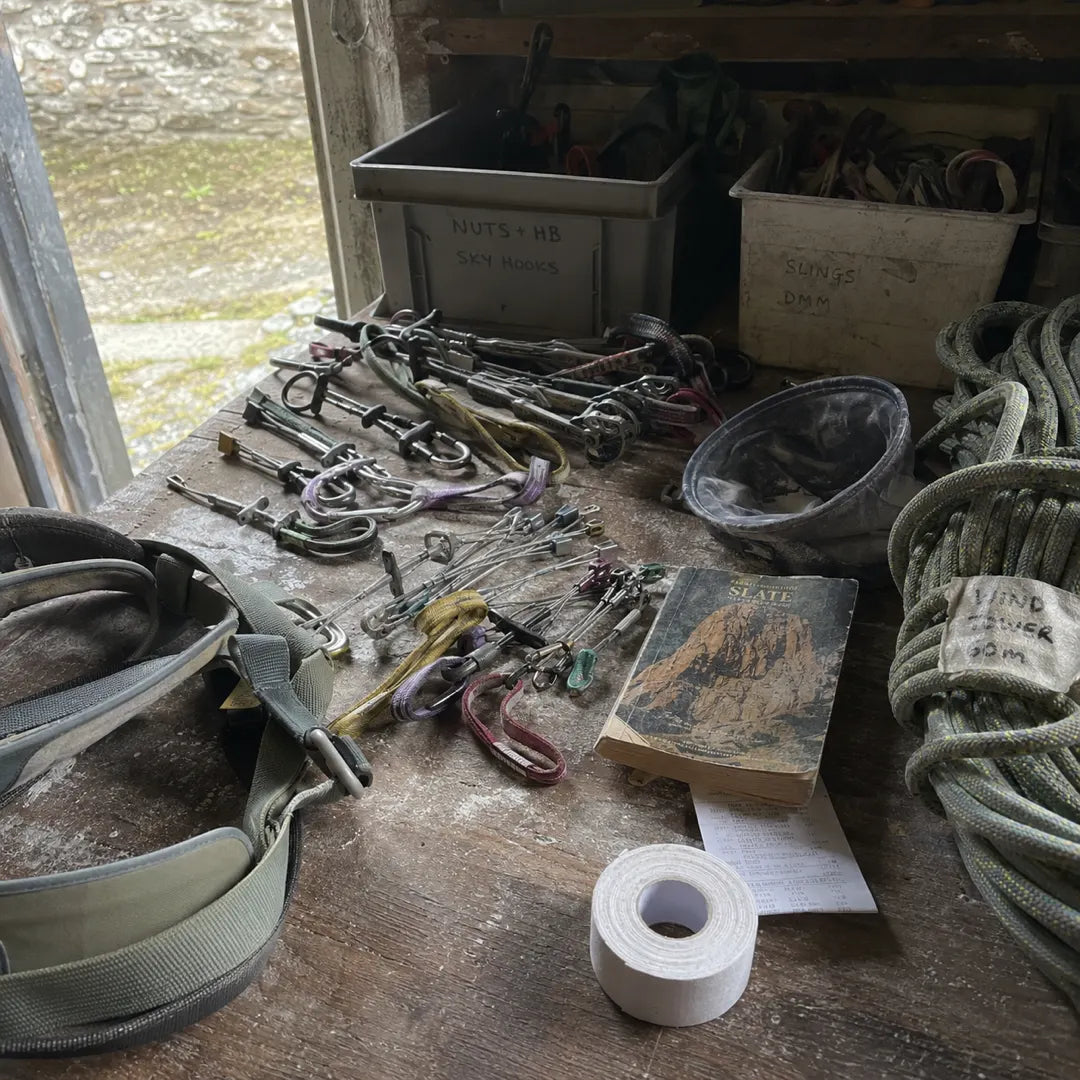
We walked out to the shed behind the house. It was full of it. Forty years of climbing.
Old hexes and stoppers on faded slings. A rack of cams worn silver at the lobes. Ropes coiled and labeled by year. A crash pad older than me. And on the workbench, bolted to a slab of oak, a hangboard Gene had cut and shaped by hand in the seventies, the edges rounded smooth from decades of skin.
That was the thing I'd come for. I'd seen it in the listing photo and I couldn't stop thinking about it. I ran my thumb along the edge of it.
Ruth watched me. She said — take all of it. Gene wanted it climbing on, not sitting in a shed.
We loaded the truck. Took the better part of an hour. When we were done she said — come inside. There's one more thing, and it's the one that matters.
She took me into a small room off the kitchen — a desk, a chair, and a wall of photographs. Gene at twenty on a granite face. Gene at fifty with a rope over his shoulder. Gene old — really old — chalk on his hands, grinning under a boulder.
On the desk was a small wooden box. She picked it up and handed it to me. She said — open it.
Inside was Gene's wedding ring. A stub of a chalk block gone smooth. And a small block of wood. Dark, oiled, worn. About the size of a bar of soap, with shallow scooped holds carved into every face.
It was smooth the way a creek stone is smooth. From skin. From years.
I picked it up. It sat in my hand like it had been made for it.
I said — Ruth. What is this.
She said — sit down. I want to read you something.
A letter from 1994
She took a folded sheet of paper off the desk. Yellow at the creases, soft from being opened a hundred times.
She said — Gene wrote this in 1994 to a young climber named Danny who kept getting hurt and couldn't figure out why. Danny lost his copy years ago. Gene kept the carbon. I'm going to read it to you.
She unfolded it. The voice was hers. The words were his.
"Danny," she read.
"You asked me why my hands still work at sixty-three when climbers half my age are getting surgery. You think I've got good genes. I don't. I've got a habit. Here's the habit, and here's why it works. Read the whole thing."
"Your fingers are two machines pretending to be one."
"There's the muscle — the part that pulls. And there's the tissue — the tendons, the pulleys, the little bands that hold the whole works onto the bone."
"The muscle learns fast. Give it a few months of climbing and it'll pull harder than you ever thought you could."
"The tissue does not learn fast. The tissue is slow, and stubborn, and it barely has any blood running through it. It doesn't feed on rest. It feeds on movement. It takes years to catch up to the muscle — and truthfully it never fully does."
Ruth kept reading. I sat there holding the little block.
"So here's what happens to almost every climber alive."
"Every season, you get stronger. And every season, the gap gets wider — the gap between what your fingers can pull and what your tissue can safely hold."
"You don't feel the gap. There's no pain. Your fingers feel fine."
"They feel fine right up until the day the gap is too wide, and you're on a move you've done a hundred times, and something lets go with a pop you'll hear for the rest of your life."
"That's not bad luck, Danny. That's a bill coming due."
"That's not bad luck, Danny. That's a bill coming due."
The engine and the frame
She paused and looked at me over the paper. Then she kept going.
"Think of it like this. Your muscle is the engine. Your tissue is the frame."
"Most climbers spend twenty years bolting a bigger and bigger engine onto the same stock frame. And it holds. It holds for a long time. Until one ordinary Tuesday, it doesn't."
"You cannot make the tissue fast. That's biology, you're stuck with it. But you can keep it awake."
"A little movement every single day. Gentle. The fingers going through their whole path — opening all the way, not just crimping shut. Enough to keep the blood in them and keep them supple. Enough to keep the gap from getting wide."
"It's not training. Don't confuse it with training. It's maintenance. Two minutes with your coffee."
"And here's the part that'll make you mad — the climbing itself will not do this for you. Climbing only ever teaches your fingers to close. Hard. It builds the engine. It does nothing for the frame."
Builds the engine. Widens the gap.
Feeds the frame. Keeps the gap narrow.
"I hangboard. Isn't that the same thing?"
I stopped her. I said — Ruth, I hangboard. I warm up. Isn't that the same thing?
She said — that's the first thing Danny asked too. Keep reading, it's in here.
She found the spot.
"You're going to tell me you already hangboard. A hangboard is more engine. It's load. It makes the strong part stronger and the gap wider. It is the opposite of what I'm telling you."
"You're going to tell me you warm up. Good. But a warm-up is five minutes right before you pull hard, and it's the same closing motion, and be honest — half the time you skip it. A warm-up is not a habit that keeps your hands for forty years."
"You're going to tell me about the rubber bands for the backs of your fingers. They're not wrong. They're half the picture, and nobody on earth keeps doing them, because they're boring."
"You're going to tell me you're careful. Careful is fine. Careful doesn't feed tissue that has no blood supply. The gap widens whether you're careful or not."
"Everything on that list is something you'll do for three weeks and quit."
"The only maintenance that works is the one you'll actually do every morning until you're old. And you'll only keep doing it if it's the good part of your day, not another chore."
"That's the whole secret. That's why mine is a game and not an exercise."
The man who taught Gene
She read the last part slower.
"I didn't figure this out. A man named Whit taught me, in 1974. He was pushing eighty and still soloing the easy stuff out here when men his age were in recliners."
"I asked him how. He told me exactly what I'm telling you. Then he handed me a little block he'd carved, off his own workbench, and told me to do it every morning for the rest of my life."
"I've done it every morning for the rest of my life."
"I'm sixty-three writing this. My hands work like they did at thirty. I'm going to climb until I die."
"If I get that wish, Danny, you'll know I was right."
Ruth folded the paper. She looked at me.
She said — Gene died last month. He got his wish. He climbed until he died. He was 84.
That's the block in your hand. The one Whit carved. Gene did it every morning for fifty years.
"That's exactly the right time to start"
I said — Ruth. I don't have finger problems. I've never even tweaked a pulley. My fingers are fine.
She said — that's exactly the right time to start.
She said — Gene started at forty-four, and he always said he wished he'd started at twenty, because he spent a few years undoing damage he didn't have to. Whit started at fifty-something.
You're thirty-nine, and you've never been hurt. You're not behind. You're ahead. That's the rarest place a climber can be.
The ones who come to this after the first surgery are playing catch-up on tissue that's already gone. You get to keep yours.
Stay ahead.
Ruth's hands
I said — Ruth, can I ask you something. She said — go ahead.
I said — your hands. On the porch, when you poured the water. I noticed them.
She smiled. She pushed her sleeve back. She held up her wrist and turned her hand over, and she opened and closed her fingers slow, all the way, through the whole path.
She said — I've done it every morning for thirty years too. Gene made me one.
I'm eighty-two. I knit, I garden, I open my own jars, and I can still hang off the porch beam longer than my grandson.
She said — this isn't only for climbers with a problem. It's for anyone who wants to keep their hands. But for a climber with good hands and thirty years of climbing still in front of him?
There's nothing smarter you could do.
"Where do I even get one?"
I said — where do I even get one. Yours are hand-carved. Whit's dead. Gene's gone.
She said — that's the thing Gene sorted out at the end.
His hands were getting too shaky to carve them for people anymore, and he had a list of young climbers he wanted to give them to. So he went looking for the closest thing to his own block that somebody was making right.
Most of what's out there is junk, he said. Cheap plastic, laser-cut, holds a real climber's fingers slide right off. He hated those.
He found one made the way he'd have made it. Solid wood. Real climbing holds you can move around, sixteen routes on it, made by hand by a tiny outfit of actual climbers.
He called it the only honest one on the market. Said they sell out half the year because there's only so many a small crew can make by hand.
It's called the Boulder Block.

She opened the desk drawer. There were four of them in there, still in the boxes.
She said — he ordered them by the pair to hand out. I've been mailing them to his list since the funeral. I've got a few left.
He said the company gives you sixty days to send it back if it's not for you. Gene liked that. Said it meant they weren't lying about it.
I didn't take one of Gene's from the drawer. Those were for his list. I ordered my own from her kitchen table that afternoon, on my phone, while she made coffee.
I drove the five hours home that night. Gene's rack was in the truck bed. His hand-built hangboard was strapped in the back seat. The little worn block and the letter were on the passenger seat where I could see them.
The one Gene went looking for. 60 days to send it back if it isn't for you.
The block by the coffee machine
My own block came that week. I put it next to the coffee machine, because that's the only way I was ever going to remember.
Week one, honestly, I felt a little stupid. Two minutes every morning, moving my fingers around a wooden block like a puzzle, before I'd even had breakfast. Nothing dramatic happened. Maybe my hands felt a touch looser. Maybe I imagined it.
But Gene's voice was in the letter and the letter was on the counter, so I kept doing it.
Week three. I noticed I was warming up faster at the gym. The first few problems used to feel creaky. Now they didn't.
There was this stiffness I used to have in my right ring finger first thing in the morning — so small I'd never once thought about it, never named it, just lived with it for years. One morning I realized it was gone. I stood in my kitchen opening and closing my hand looking for it, and it wasn't there.
Two months in. We had a crimpy session at the gym, the kind where somebody usually walks out taping a finger. A move went wrong on me. My foot cut and my whole weight snapped onto two fingers on a bad edge. The exact thing that tweaks people.
I came off it fine. Shook my hand out. Nothing.
A year ago I think that one hurts me. I can't prove that. Nobody can prove the injury they didn't get.
That's the whole point, Gene would say. The proof is what doesn't happen to you.
"Nobody can prove the injury they didn't get. The proof is what doesn't happen to you."
Eleven months later
It's eleven months later now. I still do it every morning with my coffee. It's not discipline anymore. It's just part of the day, like the coffee is.
I'm climbing as well as I ever have. Maybe a little better. I haven't been hurt.
That doesn't sound like much of a testimonial, and it isn't supposed to. It doesn't give you anything you can post about. No before and after.
What it does is keep things the same. It keeps your hands the way they are right now, which — if you've got good hands and you want to climb for another thirty years — is the only thing you actually want.
It keeps you climbing when the friends you started with are the ones going "yeah, I used to climb, my fingers are shot."
The part I didn't see coming
It's fun. And fun spreads.
My wife picked it up off the counter one morning, said "what even is this," and didn't put it down for twenty minutes. So I ordered her one.
Then my kid wanted in. So I ordered him one too — and the thing I'd been quietly dreading, getting a nine-year-old to care about his hands, happened all by itself. To him it isn't maintenance. It's a game he wins.
In the end I ordered a stack of them. One for me. One for my wife. One for each of the kids. A couple for the drawer.

My nephew started climbing last year. Somewhere in there he'd hit the age where uncles get boring and I'd lost my way back in with him. Now we sit at the kitchen table on Sundays and race the routes. I've got that hour with him again, and he thinks it was his idea.
That's the thing nobody tells you about keeping your hands for the long game. It was never only about you.
It's the example the kid copies without being told. It's the thing you'll still be doing next to your grandkids. It's the one climbers pass down, hand to hand, the way Whit passed it to Gene and Gene passed it to me.
Here's the whole of it
Two minutes of gentle movement that keeps the blood in slow tissue — the tissue that dries out and stiffens while you get stronger and stronger on top of it.
And it's fun. The good kind — where you sit down for two minutes and look up twenty minutes later still working a route, wondering where the time went. Not childish. There is nothing childish about it. It's a puzzle for your hands, and it's the smartest thing a climber can do with two minutes.
It's what the climbers whose hands still work at eighty all quietly do. The strong young ones mostly don't. Yet.
There's a 25-year-old at my gym who already can't fully straighten two of his fingers. Pushed too hard, too young, nobody told him about the frame and the engine. He's the reason I keep two spare blocks in my drawer now. I hand them out. I tell them the whole thing. The engine, the frame, the gap, Gene, Whit, the porch.
Most of them are like I was. My fingers are fine, why would I need this.
I tell them what Ruth told me. That's exactly the right time to start.
Ruth said something on that porch I think about a lot. She said — Gene climbed sixty-five years. The first forty-four he did on luck. The last twenty-one he did on two minutes a morning.
You can't buy more luck. You can buy the two minutes.
What I'd tell the climber on the mat next to me
So here it is, passed down the line from Whit to Gene to me to you.
It's called the Boulder Block. Solid wood, real climbing holds you reposition into sixteen routes, made by climbers who make it the honest way instead of the cheap way. Sixty days to send it back if it's not for you.
Once I started looking, I found plenty of things that photograph like it. Here's what I actually found when I put them side by side:
How they stacked up, side by side
| What to check | Boulder Block |
What I found elsewhere |
|---|---|---|
| Material | ✅ Solid wood, hand-finished | Cheap plastic, laser-cut |
| The holds | ✅ Real climbing holds you reposition — 16 routes | Molded grips your fingers slide off |
| Who makes it | ✅ A small crew of actual climbers, by hand | Mass-produced, often unclear |
| Will you keep doing it? | ✅ It's a game — 2 minutes with your coffee | Rehab tools you quit in 3 weeks |
| Guarantee | ✅ 60 days, money back, no questions | Frequently none |
Solid wood, 16 routes, handmade in small batches — and 60 days to change your mind.
What other climbers say
"Warm-ups used to eat half my session. Three weeks with this thing next to the kettle and I'm pulling on real holds in ten minutes."
"Bought it for my husband after his second pulley tear. He does it with his coffee, like the letter says. First thing that's ever actually stuck."
"I'm the guy at the gym with the tape. Should have started this at 30. My kid keeps stealing it off the counter, so I ordered a second."
The only thing it ever costs you is the two minutes
Here's the practical part, the way I'd want a friend to give it to me.
You get 60 days to try it. Do it every morning with your coffee. If your hands don't feel more looked-after than they have in years, you send it back and you get every penny back — no questions, no hoops. You're not signed up for anything you didn't choose. One block, one-time purchase.
Get one for you. Get one for the kid climbing next to you. The younger they start, the more of their hands they keep.
Do it so that in thirty years you're the old climber at the crag that some 39-year-old drives five hours to buy a rack from. The one whose hands still work.
I'll know you by your hands.
Guarantee
One-time purchase — you're not signed up for anything you didn't choose.
60 days to send it back. Every penny, no questions.
- 60-Day Money-Back Guarantee
- Solid wood, made by hand
- Real climbing holds — 16 routes
- Made by a small crew of actual climbers
- Sold out 12 times last year
— Matt K., 39 · California