

A good climbing move is rarely just a hard squeeze. It can ask for a thumb pressed against an edge, fingertips placed carefully on a small hold, or a quick adjustment when a grip does not feel secure. Playing the Boulder Block™ brings those hand positions into a small, repeatable game you can pick up without setting up a session.
It is not gym equipment, and it is not intended to replace climbing. It is a wooden block about 10cm across, roughly the size of a large orange, designed to sit comfortably in one adult hand. Twelve screw-on resin climbing holds cover its faces. The task is simple: follow a route card, use the holds it specifies, and work out how to keep the block in your hand as the sequence changes.
That simple format gives grip, pinch, and finger control something specific to do. Rather than asking your hands to make one repeated effort, each route asks them to respond to the shape, position, and order of the holds in front of them.
More than one way to hold on
The Boulder Block does not present one fixed grip. A route may ask you to wrap your fingers around a hold, press a thumb into a pinch, support the block from its side, or keep a fingertip in position while the rest of your hand finds the next move. The changing orientation matters. Turning the block changes where the next hold sits and how your hand approaches it.
This makes the game a hands-on puzzle. You are not simply trying to keep a grip for as long as possible. You are deciding where each finger goes, how much contact feels available, and whether a different hand position gives you a better chance of completing the route.
The resin holds are the same material used on a climbing wall. Their shapes give the fingers and thumb distinct points to work with, instead of leaving the hand to grip a smooth object in the same way every time. A hold can invite a pinch, an open-handed contact, or a more careful fingertip placement depending on the route and how the block is turned.
Finger placement becomes the game
On a wall, a climber often has only a moment to choose where a hand belongs. On the Boulder Block, the route is small enough to inspect closely. You can look at the next hold, turn the block in your hand, try an approach, lose the position, and begin again. There is no need to rush through it.
That is where finger control comes into the experience. Some moves ask for a finger to stay on a hold while another finger reaches. Some ask the thumb to take an active role. Others make it clear that a broad, comfortable grip will not fit the sequence. The route card sets the constraint; your hand works through the details.
There are 32 printed routes across 4 levels, from Yellow through Purple. Early routes provide a straightforward introduction to the format. Later routes place more demands on accurate placement and on keeping track of the sequence. They are not a prescribed workout plan. They are routes to play, revisit, and solve at your own pace.
A small problem worth picking up
Large training setups can be useful, but they also ask for a dedicated time and place. The Boulder Block is made for the quieter gap between other things: a few attempts at a route on a table, a turn while talking with friends, or a short pause at home. Its value is in being easy to pick up again.
A hangboard is the stronger tool for focused finger-strength training. The Boulder Block has a different job. It wins on being a game people are inclined to pick up daily, because every route offers a contained challenge rather than a formal training session. For a clear look at the distinction, read our guide to training finger strength at home.
There is no score you have to chase and no required number of attempts. You can stay with a route until the hand positions make sense, set it down, and return later. The point is the interaction: fingers, thumb, palm, holds, and the next move on the card.
Routes can change when the block changes
The holds are not molded as one fixed piece. Each of the 12 resin holds screws onto the wooden block and can be removed with an Allen key. That means the same block can be rebuilt into a different route layout. Moving a hold changes the available grips and changes the decision-making required by a route.
This rebuildable design is central to the game. A route is not only about which colored holds to use. It is also about where those holds sit, which direction the block faces, and what your fingers can reach from the position they are already in. Rebuilding gives the game another layer without turning it into a piece of gym equipment.
It also distinguishes the original from products that can look similar in a picture. Buyers have told us that cheaper copies are typically molded plastic in one piece and often arrive without a route deck. We have also heard descriptions including “slippery,” “slick,” and “the holds have no texture to them.” If you are comparing what you have found, our page on telling the original from a copy shows what to look for.
One adult-hand size, with room to grow into it
The Boulder Block comes in one size, sized for an adult hand. It suits roughly age 8 and up and is generally comfortable from about 10, though hand size matters more than age. A smaller hand may approach the holds differently from a larger one, which is part of why routes can feel different from person to person.
There is no need to make every route look the same. A player can take time, turn the block, reset a finger, or decide that a hold is better approached from another side. The game asks for attention to contact and position, not a particular climbing background.
For climbers, that can make it a familiar kind of challenge in a very small format. For someone new to climbing, it is an accessible way to explore the difference between holding, pinching, balancing the block in the palm, and placing fingers with intention. In both cases, the route provides the structure.
Made to be given, played, and rebuilt
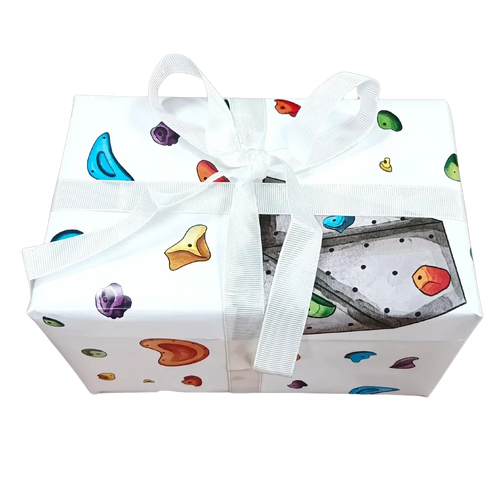
Climber’s Gift sells the Boulder Block direct at climbersgift.com. Since February 2024, we have shipped 25,286 orders to 50+ countries. Every order arrives gift-ready, with no prices in the box. Customs duties are pre-paid, so the checkout price is final.
We also offer 60-day money-back returns. If a hold breaks, we replace it free with no proof required. Those policies are there because this is a physical game meant to be handled, passed around, rebuilt, and played.
If you want the complete details of the holds, route deck, and current availability, see the Boulder Block. It is a compact climbing game for hands that enjoy working through a problem: one hold, one pinch, one careful finger placement at a time.