


The first week with a Boulder Block™ is not about proving anything. The Yellow routes are there to get the game into your hands quickly: take the block, find the holds shown on the card, and work through the sequence with your fingers.
They are meant to be completable on day one. That does not mean every first attempt will be smooth. Most new players find that the challenge is less about pulling hard and more about slowing down long enough to understand what each route is asking.
Boulder Block is a wooden block about 10cm across, roughly the size of a large orange. It sits comfortably in one adult hand. Around it are twelve screw-on resin climbing holds, made from the same material used on a climbing wall. The printed deck has 32 routes across four levels, beginning with Yellow and continuing through Purple.
Begin with the card, not a guess
It is tempting to pick up the block and start trying random holds. That is a perfectly good way to explore it, but it can make a Yellow route seem harder than it is. Start by looking at the route card. Find the indicated holds and trace the order with your eyes before putting your fingers on the block.
A route is a small problem. The card gives it structure. Once you know where the next hold is, you can pay attention to the move itself instead of searching around halfway through it.
On the first few tries, keep the block still in one hand and use the fingers of the other hand to climb. There is no need to rush. A pause between holds is part of learning the route. If you lose your place, return to the card and begin again rather than trying to rescue a sequence you can no longer remember.
What usually feels difficult at first
The first surprise for many people is how much attention a short sequence takes. A Yellow route may only ask for a few deliberate moves, but each one asks you to choose a finger, place it accurately, and keep the previous fingers where they are. It is easy to focus on the next hold and accidentally let go of the one that was doing the work.
Try thinking one move ahead rather than several. Look at the hold you are about to use, decide which finger will go there, then make the move. Once it is secure, consider the next one. Breaking the route into small decisions makes the card easier to follow.
Another common difficulty is using more force than the route needs. New players often squeeze the block tightly with the hand holding it or press very hard with the climbing fingers. That can make the movement feel awkward. Hold the block securely, but leave room for the climbing hand to make a careful placement. Yellow routes reward control more than urgency.
Finger choice can also feel unfamiliar. You may naturally reach with your index finger for every hold, even when another finger is closer or better placed. There is nothing wrong with experimenting. If a move repeatedly feels cramped, reset and try approaching it with a different finger. The point is not to copy a particular style. It is to solve the route in a way that makes sense in your hands.
Give each attempt a clean start
When a route falls apart near the end, the useful response is usually a full restart. Begin at the first hold and repeat the sequence at an even pace. The earlier moves often set up the awkward one later on. A clean attempt lets you notice whether the issue was the difficult hold itself or the position you arrived there from.
It helps to name the problem plainly. Perhaps you forgot the order. Perhaps one hold is hard to reach without shifting your grip. Perhaps you are moving too quickly. Once you know which of those happened, the next attempt has a purpose.
Keep early sessions short enough that the game remains enjoyable. One route completed cleanly is a good place to stop, especially on the first day. You can return later and find that the sequence is easier to remember. The block is made to be picked up often, not turned into a long workout.
Yellow is a place to learn the game
The Yellow routes are not a test of whether someone is a climber. They are the starting point for learning how the deck works and how the holds feel in your own hand. Someone who climbs regularly may move through them quickly. Someone entirely new to climbing may take longer. Both are using the same small puzzle as intended.
Hand size matters more than age. Boulder Block comes in one size and is sized for an adult hand. It suits roughly age 8 and up, and is generally comfortable from about age 10. For a younger player or anyone with smaller hands, a route can ask for a different reach and a different finger choice. There is no need to force a move that does not fit comfortably. Put the block down, come back to it, or choose another Yellow card.
Once a Yellow route becomes familiar, try it again with a little more care rather than simply trying to finish faster. Notice where you tend to hesitate. Notice which finger you select without thinking. Those details are where the game stays interesting after the first completion.
When to move beyond Yellow
Move on when Yellow routes feel understandable, not when every attempt is perfect. If you can read a card, find the holds, and make your way through the sequence without feeling lost, you are ready to see what the next level asks. You can always return to Yellow. Routes do not expire, and there is no required order beyond the one that keeps the game enjoyable.
The twelve holds unscrew with an Allen key, so the block can be rebuilt into a different route. That matters after the first week as much as it does on the first day. The deck gives the route to follow, while the screw-on holds make a new setup possible. It is a game built around revisiting a familiar object and finding a new problem in it.
If you are comparing one to a copy, look at how to tell the original from a copy before ordering. Buyers who contacted us about cheaper copies have described them as “slippery” and said “the holds have no texture to them.” Copies are typically molded plastic in one piece rather than a wooden block with screw-on resin holds, and they usually arrive without a route deck.
A game first, with room for a routine
Boulder Block is not gym equipment. You climb it with your fingers because solving the route is satisfying, whether it lives on a desk, a shelf, or beside the place where you usually sit down. Its advantage is that it can be picked up for a route without setting aside a full session.
Hangboards are the stronger training tool for people whose goal is training. For a straightforward comparison of the two approaches, read about training finger strength at home. Boulder Block wins on being easy to pick up daily: a card, a small sequence, and a reason to try one more time.
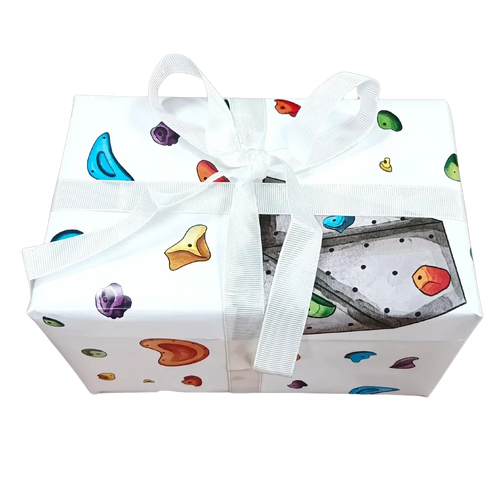
Climber's Gift sells direct at climbersgift.com. Since February 2024, we have shipped 25,286 orders to 50+ countries. Orders arrive gift-ready, with no prices in the box. Customs duties are pre-paid, so the checkout price is final. There are 60-day money-back returns, and broken holds are replaced free with no proof required.
For the first week, stay with Yellow, use the cards, and let the small mistakes be part of learning the game. The first completed route is not the finish line. It is the moment the block starts making sense.