

Hard routes on a small block are not hard because the block is trying to be a climbing wall. They are hard because the next hold can ask for a very particular finger position, and because the sequence leaves little room to ignore it. On the Purple level, a route can look simple at first glance, then become unexpectedly exact once you try to connect the holds in order.
Boulder Block™ is a game made by Climber's Gift: a wooden block about 10cm across, roughly the size of a large orange, made to sit comfortably in one adult hand. It has twelve screw-on resin climbing holds and a printed deck of 32 routes across four levels, from Yellow through Purple. You climb the routes with your fingers, following the card rather than making up an arbitrary grip sequence.
What makes a Purple route difficult
Difficulty does not have to come from a larger object or a longer session. It can come from the relationship between one hold and the next. A Purple route can require a precise crimp, a pinch that has to be held at an awkward angle, or a change in hand position that makes an earlier hold feel different.
That is the point of the route deck. The holds stay on the same small wooden block, but the route tells you which holds matter and in what order. A hold that feels generous in a Yellow route may become a problem in a Purple route when it is paired with a smaller edge or a less convenient pinch.
It is tempting to judge a route by whether every hold feels easy in isolation. That misses what the game is asking of you. The challenge is in the sequence. You are deciding where to place your fingers, how much of an edge to use, and whether a grip still works once the route directs you onward.
Crimps are about placement
A crimp is not simply a small hold. On a compact game like this, it is a hold that makes finger placement matter. A slight shift can change how much surface is available to your fingertips. Some attempts feel settled immediately. Others make you pause, reset, and try to find a cleaner position.
That makes crimps especially useful in the upper route levels. They turn a familiar hold into a decision. The route may not allow the broad, comfortable grip you would choose first. Instead, it asks you to use the part of the hold the sequence has made available.
There is no need to rush a crimp route. Start with the route card, identify the intended holds, and take time to understand the order. If a move does not go, that is information about the route. Try a different finger placement before assuming something is wrong with the block.
Pinches change the problem
Pinches ask for a different kind of attention. Rather than settling your fingers onto an edge, you have to find a useful way to squeeze and stabilize the hold in your hand. On a small object, the angle of the block matters too. Turning it slightly can make the next move feel entirely different.
That is why a route with pinches can be difficult even when the hold itself looks obvious. The challenge may be reaching it from the preceding hold without losing your place in the sequence. A Purple route can combine a pinch with a crimp so that the hand has to change position instead of remaining comfortable.
The resin holds are the same material used on a climbing wall, and they screw onto the wooden block with an Allen key. When you want a different challenge beyond the printed routes, the block can be rebuilt into a different route. Changing the arrangement changes the relationship between holds, not just their appearance.
Why hand size matters
Boulder Block comes in one size, sized for an adult hand. It suits roughly age 8 and up and is comfortable from about age 10, but hand size matters more than age. That is particularly clear on advanced routes.
Short fingers can make some routes genuinely harder. A hold that another player can reach with a relaxed placement may require a shorter-fingered player to use less of the hold, approach it from a different angle, or make a more exact transition. That is not a flaw in the route or a defect in the product. It is part of how a hand-sized climbing game works.
The same is true in the other direction. Larger hands may make a particular edge feel different, while making another part of the route more crowded. The block is not meant to produce identical attempts for every hand. It gives each player the same route instruction and lets the shape and reach of their own hand become part of the puzzle.
For families or groups, this is often where the interesting comparisons start. Two people can follow the same card and arrive at different solutions. One might prefer a deep pinch, while another finds a better position on a crimp. The route remains the same, but the decisions are personal.
Difficulty is not a defect
A Purple route is allowed to stop you. It is allowed to take more than one attempt, or to feel impossible until a small adjustment makes the sequence click. The route deck is not a list of promises that every card will be equally comfortable for every hand.
When a route asks for a crimp or pinch that feels particularly demanding, begin by checking the card and the hold order. Make sure you are not skipping a hold or starting from an unintended position. Then try again with a deliberate placement. The game rewards attention to the sequence rather than force or speed.
If the printed deck has become familiar, rebuilding the twelve screw-on holds offers another way to keep the game interesting. The same hold shapes can create a new set of decisions when their positions change. Keep the block in your hand, set a clear sequence, and see what the new arrangement asks of your fingers.
The original is built to be rebuilt
There is confusion around copies of this product, especially listings that use similar pictures or language. The practical difference matters for advanced routes: Boulder Block has separate screw-on resin holds and a printed route deck. Buyers have told us that copies are typically molded plastic in one piece and often arrive with no route deck.
We have also heard buyers describe copies as "slippery," "slick," and "the holds have no texture to them." Those are reports from buyers, not our testing of another seller's product. If you are comparing listings, read our guide to telling the original from a copy.
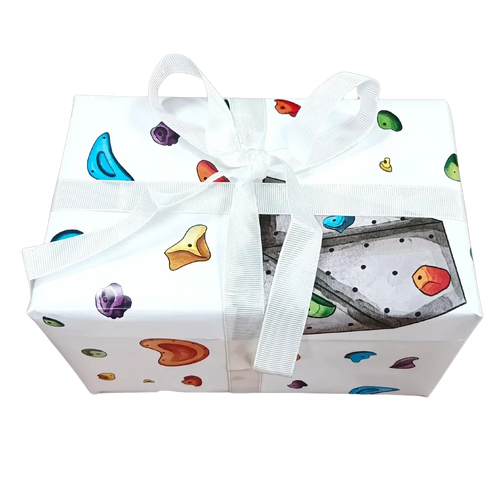
The original Boulder Block is sold direct at climbersgift.com. Since February 2024, we have shipped 25,286 orders to 50+ countries. It arrives gift-ready, with no prices in the box. Customs duties are pre-paid, so the checkout price is final. There are 60-day money-back returns, and broken holds are replaced free with no proof required.
A small game with room to grow
The Purple level is not a finish line. It is where the route deck makes its demands clearer: a crimp must be placed carefully, a pinch must be approached well, and a hand size difference can become meaningful. Those details are what give a compact finger-climbing game its replay value.
For the complete set of route cards and screw-on resin holds, see Boulder Block™. If you are also looking for context on training finger strength at home, we explain where a small daily game fits alongside more focused climbing tools.