

Open the box and the contents are straightforward. Boulder Block™ is a wooden block about 10cm across, roughly the size of a large orange. It is made to sit comfortably in one adult hand. Around it are twelve screw-on resin climbing holds, an Allen key for changing their positions, and a printed route deck.
That is the complete idea: a small climbing game with parts you can rearrange and routes you can follow. It is not a collection of built-in training attachments, and it does not come with bands, boards, or other add-ons. The game is in the block, the holds, and the route cards.
The wooden block
The block is the base for every route. Its size is intentional. It is large enough to hold comfortably in an adult hand, while remaining small enough to leave on a desk, table, shelf, or coffee table between attempts.
You climb it with your fingers, moving from hold to hold while keeping the block in your hand. There is no wall to mount, no setup area to clear, and nothing to stand on. Pick it up, choose a route, and work through it.
There is one size. It suits roughly age 8 and up, and is generally comfortable from about 10. Hand size matters more than age, so it is worth considering the person’s hand rather than treating the suggested age as a fixed rule.
Twelve screw-on resin holds
The block comes with twelve separate resin climbing holds. Resin is the material used on a climbing wall, so these are actual little climbing holds rather than molded shapes that are permanently part of the block.
Each hold screws onto the wood. The included Allen key lets you unscrew them, move them, and fasten them again in a new arrangement. Rebuilding the layout changes the route in a practical way: the hand positions, reaches, and sequence can all feel different when the holds move.
This is an important difference between the original and many cheaper copies. Buyers who have contacted us about copies commonly describe one-piece molded plastic designs, often without a route deck. Some have called the surfaces “slippery,” “slick,” or said “the holds have no texture to them.” Another buyer described a copy as “plastic and slippy.”
Those are buyers’ reports, not our testing of another seller’s product. The useful point is simpler: separate screw-on resin holds are part of what comes with the original. If you are comparing listings or buying for someone else, read our guide to telling the original from a copy.
The holds are there to be used and rearranged. They are not decorative pieces and they are not fixed into a single permanent route. The Allen key is included because changing the layout is part of the game.
The printed route deck
Also in the box is a printed deck of 32 routes across 4 levels: Yellow, Green, Blue, and Purple. The cards give the game structure. Rather than looking at the block and making up a sequence every time, you can take a card and follow the indicated route.
The color levels make it easy to choose where to begin and where to go next. A person can return to a route, work on one that asks for more careful finger placement, or rebuild the block and start again with a different configuration. The deck provides the direction; the movable holds keep the block from being locked into one arrangement.
It also makes Boulder Block easier to give as a gift. The recipient does not need to understand climbing terminology or design a route before they can begin. The cards explain the game through the routes themselves.
For climbers, the appeal is often the small, repeatable challenge of reading a sequence and making the moves with the fingers. For people new to climbing, it is a tactile puzzle with a clear starting point. It is a game, not a piece of gym equipment.
What is not in the box
Clarity matters because this product has been described inaccurately in the past. Boulder Block does not include a fingerboard, resistance bands, interchangeable handles, digital tracking, or a set of built-in training tools. It is not intended as a substitute for a hangboard.
A hangboard is the stronger tool for focused training. Boulder Block has a different role: it is easy to pick up during the day, engaging enough to revisit, and compact enough to keep nearby. If you want more context on the distinction, read about training finger strength at home.
The point is not to turn every spare moment into a formal session. It is to have a small climbing game that asks for attention from the fingers and gives you routes to solve without preparing a dedicated training space.
How the pieces work together
The wood gives the game its shape. The resin holds provide the contact points. The Allen key makes rearrangement possible. The route deck gives each attempt a defined sequence and a level to select. Remove any one of those parts and the experience changes.
That is why a one-piece plastic item without a route deck is not the same thing, even if it looks similar in a photo. The original is designed around rebuildable holds and printed routes, not simply around the outline of a block.
We make it direct at Climbers Gift, and it is sold through climbersgift.com. Since February 2024, 25,286 orders have shipped to 50+ countries. The product page for Boulder Block™ shows the version we make and sell.
What to expect when it arrives
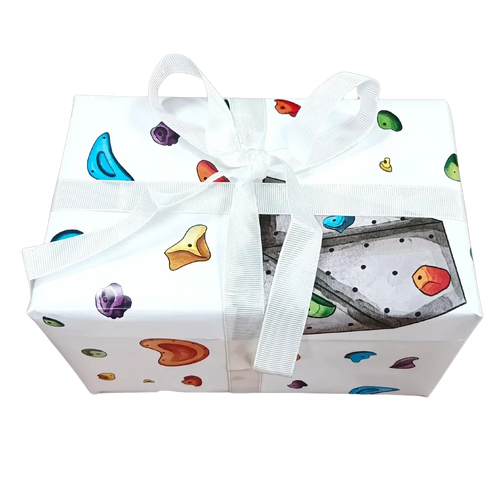
It arrives gift-ready, with no prices in the box. That is useful whether you are sending it directly to someone or keeping the delivery simple at home. Customs duties are pre-paid, so the checkout price is final.
If it is not right for the recipient, there is a 60-day money-back return policy. If a hold breaks, we replace it free with no proof required. Those policies apply to the product we make, with the twelve screw-on resin holds, Allen key, and printed route deck included.
A compact game with real parts
Boulder Block is deliberately uncomplicated. There is a wooden block sized for an adult hand. There are twelve resin holds that screw on and off. There is an Allen key to move them. There is a printed deck of 32 routes across Yellow, Green, Blue, and Purple.
Nothing needs to be added before the game can begin. Nothing extra needs to be learned to understand what is in the box. Choose a card, hold the block, and climb the route with your fingers. When the layout has become familiar, use the Allen key, rebuild it, and choose the next route.