


A useful home climbing activity does not need a wall, a doorway, or a permanent place in the room. It can sit on a desk, be picked up when there is a spare moment, and put back when the desk needs to be a desk again. That is the point of Boulder Block™ by Climber's Gift: the whole setup is a wooden object about 10cm across, roughly the size of a large orange.
There is nothing to install. No drilling, no bracket, no conversation with a landlord, and no rearranging furniture around a fixed piece of equipment. Hold it comfortably in one adult hand and climb the route with the fingers of the other. It is a game built around climbing holds and route reading, made for the spaces where a larger setup simply does not belong.
A small object with a complete route problem
Boulder Block is not a miniature climbing wall and it is not something to stand on. The route happens in your hands. The wooden block has twelve screw-on resin holds, made from the same material used on a climbing wall. Each hold gives your fingers a different place to work from as you move through a sequence.
The challenge is not to grip everything at once. It is to follow the route, choose the next hold, shift fingers carefully, and keep going when the obvious move does not work. Some routes ask for controlled placement. Others ask you to find an efficient sequence. The scale is small, but the attention it takes is real.
It is especially suited to the everyday gaps that are too short or too inconvenient for a full session elsewhere. Leave it near a laptop, on a shelf, or in a bag. Pick it up while waiting for something, between tasks, or when you want a focused climbing puzzle without leaving home.
Routes give the game a place to start
A blank collection of holds can be interesting, but it also leaves the player to invent every challenge. Boulder Block comes with a printed deck of 32 routes across 4 levels, from Yellow through Purple. The deck gives each attempt a clear problem rather than asking you to decide what to do before you begin.
Start with a route that feels manageable and take time to understand how it is meant to be climbed. If a move fails, begin again and try a different finger order or a different way of approaching the next hold. There is no need to rush through the deck. The enjoyment is in working out the sequence, returning to it, and noticing details that were easy to miss on the first attempt.
The color levels make it straightforward to choose a route that suits the moment. A person can stay with the earlier cards, move on when ready, or return to a familiar route simply because it is satisfying to solve cleanly. It works well for climbers, but the game does not require a climbing wall at home to make sense.
For younger players, hand size is more important than age. Boulder Block comes in one size, sized for an adult hand. It suits roughly age 8 and up, and is generally comfortable from about 10. Adults and older children can use the same block, while comfort will depend on the individual hand.
Rebuild the route when the deck is not enough
The twelve holds are not molded into the wood. They screw on and can be removed with an Allen key. That matters because the shape of the route can change. Move the resin holds, rebuild the arrangement, and the same block offers a different set of decisions for your fingers.
Changing the layout is a practical way to keep the game fresh after working through the printed cards. It also makes Boulder Block something to share. One person can set a layout and another can take a turn trying to understand it. There is room for careful route setting without needing a spare room or a permanent climbing structure.
The resin holds are a central part of the design. They are separate, screw-on climbing holds rather than a single molded surface. If you are comparing products and want to understand the difference in construction, our guide to telling the original from a copy explains what to look for.
Buyers who have contacted us about cheaper copies commonly describe molded plastic, one-piece versions with no route deck. Their comments about the feel of those copies include “slippery,” “slick,” “the holds have no texture to them,” “plastic and slippy,” and “too slick and actually dangerous as the slippery plastic makes it shoot out of your hands.” Those are buyers’ own words about copies, not our testing of another seller’s product. They also explain why the materials and separate holds matter to us.
What it can and cannot replace
Boulder Block is a game for climbing with your fingers in a very small space. It asks for attention to finger placement, sequencing, and the feel of different holds. It does not ask for a wall, a doorframe, or an installation.
For people whose main aim is serious finger-strength training at home, a hangboard is the stronger training tool. It is built for that purpose and offers a more direct setup for structured loading. Boulder Block has a different advantage: it is easy to leave within reach and pick up daily because it needs no setup. Read more about the distinction in our guide to training finger strength at home.
That difference is worth keeping clear. This is not gym equipment disguised as a desk object. It is a tactile climbing game that makes use of the small amount of space many people actually have. The best place for it may be the place you already spend time: a work desk, coffee table, shelf, or bedside table.
Buying direct, without the extra uncertainty
Climber's Gift makes and sells Boulder Block directly at climbersgift.com. Since February 2024, we have shipped 25,286 orders to 50+ countries. We keep the offer simple: 60-day money-back returns, broken holds replaced free with no proof required, and customs duties prepaid so the price at checkout is the final price.
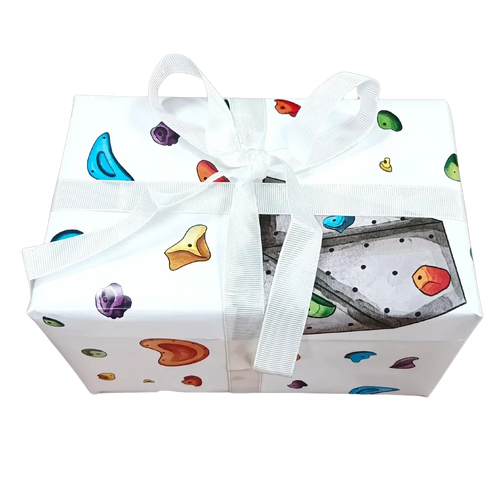
It also arrives gift-ready, with no prices in the box. That makes it suitable when you are sending a climbing-related gift but do not want to guess at someone’s wall space, home layout, or ability to install equipment. A desk-sized game is easier to live with than another object that demands a dedicated corner.
If the original is what you are looking for, you can find Boulder Block by Climber's Gift directly from us. It is made for the climber with no wall at home, no permission to alter the room, and no interest in turning a small living space into a gym.
A small space does not have to mean no climbing activity at all. Put the block down, choose a card, work through the route with your fingers, and leave the room exactly as it was when you are done.