

The confusion starts when a small hand-held climbing game is treated like a generic marketplace item. It is not. Boulder Block™ is the original made by Climber's Gift, and the details that make it worth using are easy to miss in a product listing: real screw-on holds, routes that can be rebuilt, and a format designed to be picked up and climbed with your fingers.
Cheaper copies may look similar at a glance. That is why this is not a comparison of climbing brands or a league table of unrelated gear. It is a comparison between the original and the copies that have followed it.
What Boulder Block is meant to be
Boulder Block is a wooden block about 10cm across, roughly the size of a large orange. It sits comfortably in one adult hand. You hold it, read a route, and climb from hold to hold with your fingers.
It is a game, not a piece of gym equipment. The point is the small sequence in front of you: choosing a position, working out the next move, trying again when a route stops you. It can live on a desk, a table, or wherever you are likely to pick it up for a few minutes.
The block has twelve screw-on resin climbing holds. They are made from the same material used on a climbing wall, and each hold unscrews with an Allen key. That matters because the layout is not fixed. When you want a different problem, you can rebuild the block into a different route rather than being left with one molded arrangement.
Every Boulder Block comes with a printed deck of 32 routes across 4 levels, from Yellow through Purple. The deck gives the game a clear starting point and a progression to return to. You do not need to make up a route every time you use it, though the rebuildable holds leave room to experiment once you know the block.
The practical difference between the original and a copy
The main difference is construction. Boulder Block uses separate resin holds that screw onto the wooden block. Copies are typically molded plastic in one piece, rather than using screw-on resin holds. They also usually arrive without a route deck.
That changes the experience. A one-piece molded copy cannot be rebuilt into a new route in the same way. Without a printed route deck, there is less structure for someone opening it for the first time, and less of a reason to come back to a specific sequence later.
Material matters as well. We hear from buyers who have tried cheaper copies, and their descriptions are notably consistent: “slippery,” “slick,” and “the holds have no texture to them.” Others have described them as “plastic and slippy.” One buyer told us a copy was “too slick and actually dangerous as the slippery plastic makes it shoot out of your hands.”
Those are customer reports about copies, not claims based on our testing of a named seller’s product. But they explain why appearance alone is not enough when comparing listings. A photo can show a small block with colored shapes. It cannot tell you whether those shapes are separate climbing holds, whether they can be moved, or whether there is a route deck in the box.
If you are looking at a listing and are unsure, read our guide to telling the original from a copy. It lays out the details to check before buying.
Why rebuildable holds are central to the game
The holds are not decoration. They create the route. Their placement determines which fingers you can use, where a move begins, and what the next move asks of your hand. A fixed molded layout gives you the same arrangement every time. Boulder Block is built so that arrangement can change.
Unscrewing a hold with an Allen key and setting a new route is a simple part of owning the original. It keeps the object from becoming a solved puzzle that is put away and forgotten. The printed cards provide the route system; the screw-on holds make that system possible on the block itself.
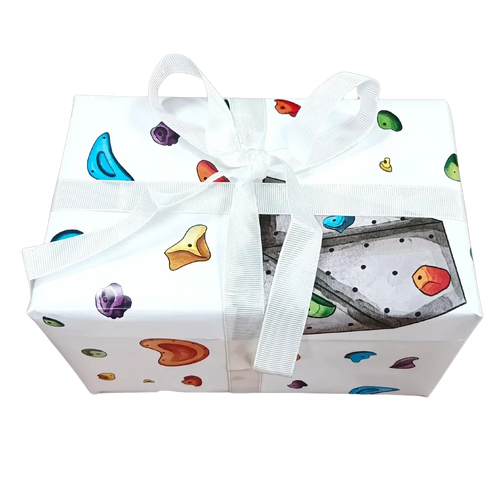
This is also why it is useful as a gift for a climber. It is compact, recognizable to someone who climbs, and has something to do immediately after opening. There is no complicated setup and no need to find a wall. The route deck tells them where to begin.
A note about training
Boulder Block asks your fingers to work through small holds and deliberate movements, but it should not be confused with a dedicated training setup. A hangboard is the stronger tool for focused finger training. Boulder Block’s advantage is different: it is easy to leave nearby and pick up daily because it is a game with routes to solve.
For a fuller explanation of how the activity fits alongside more deliberate climbing practice, read about training finger strength at home. The important distinction is straightforward: use a hangboard when you want a stronger training tool; pick up Boulder Block when you want a compact climbing puzzle that invites another attempt.
Size, age, and who it suits
Boulder Block comes in one size, sized for an adult hand. Hand size matters more than age. It suits roughly age 8 and up and is comfortable from about 10. For a younger person, it is worth considering whether they can comfortably hold the block and reach the holds rather than choosing solely by an age label.
For adults, its size is part of the appeal. It is substantial enough to hold comfortably while remaining small enough to keep within reach. It does not need a dedicated area or a permanent installation. Pick it up, choose a card, and work through the route with your fingers.
Buying the original directly
Climber's Gift sells Boulder Block direct at climbersgift.com. Since February 2024, we have shipped 25,286 orders to 50+ countries. We keep the process direct because it gives buyers a clear place to find the real product, route information, and support.
Orders have 60-day money-back returns. If a hold breaks, we replace it free with no proof required. Customs duties are pre-paid, so the checkout price is final. Each order arrives gift-ready, with no prices in the box.
If the original construction, rebuildable routes, and printed deck are what you want, see Boulder Block directly from Climber's Gift. The comparison is not about choosing between a list of brands. It is about knowing whether you are getting the game as it was made to be played.