

For many professionals, the hard part is not finding another item to put on a table. It is finding an activity that someone will actually choose to pick up, look at, and try again. Compliance is often the practical problem. A task can be simple to explain and still be ignored if it feels like another assignment.
That is why some professionals buy the Boulder Block™. It is a small finger-climbing game rather than a piece of gym equipment: a wooden block about 10cm across, roughly the size of a large orange, made to sit comfortably in one adult hand. The point is to follow a route with your fingers and work out the next move.
A buyer who identified themselves as a PT told us, "I am a PT. My hands are my tools"
Another buyer told us, "Use it with students during sessions"
Those comments are not a promise about how the game will fit every setting. They do explain why its format has found a place with people who work one-to-one or in small groups. It is compact, self-contained, and gives someone a visible problem to solve without needing a wall, a large setup, or a long explanation.
A game with a clear task
The Boulder Block is climbed with the fingers. It has twelve screw-on resin climbing holds, made from the same material used on a climbing wall. A printed deck provides 32 routes across four levels, from Yellow through Purple.
Each route gives the activity a starting point. Instead of being handed a general instruction to use the block, the player can look at a card and attempt a particular sequence. The four levels make it easier to choose an appropriate place to begin, then move on when a route has become familiar.
For a professional, that structure can be useful in a practical way. There is a defined challenge available immediately. It can be used as a short activity, revisited later, or left out for someone to notice and choose. The focus stays on the route in front of the player: where to place a finger, which hold comes next, and whether the sequence can be completed.
It is important to describe it accurately. Boulder Block is a game. It is not a climbing wall, a hangboard, or a replacement for purpose-built training equipment. People looking for a broader discussion of training finger strength at home can find that separately, but this product is made to be picked up and played with.
Routes can change with the person using it
One fixed puzzle eventually becomes familiar. Boulder Block was made so it does not have to remain fixed. The twelve resin holds unscrew with an Allen key, allowing the block to be rebuilt into a different route.
That means the physical object can stay the same while the route changes. A professional does not need a collection of different games to present a new sequence. The route deck offers a set of choices, and the screw-on holds make those choices possible on the block itself.
The printed deck is also useful when an activity needs a clear boundary. There are 32 routes rather than an open-ended instruction. Yellow through Purple gives a straightforward way to select a route without making the block feel like a single, unchanging puzzle.
The experience remains tactile and direct. Players hold the wooden block in one hand and climb it with the fingers of the other. The holds are resin, not molded into the body of the block. That distinction matters both to the feel of the game and to the ability to rebuild it.
Why the original construction matters
There is understandable confusion around copies. Buyers have told us that some cheaper versions are "slippery," "slick," and that "the holds have no texture to them."
We do not name or test other sellers’ products. What we can say is that buyers tell us copies are typically molded plastic in one piece and usually arrive without a route deck. That is a different format from a wooden block with separate screw-on resin holds and a printed deck of routes.
For a professional deciding what to put in front of a student or client, the route deck is not an extra detail. It is what turns the object into a repeatable game with an instruction already built in. Separate holds matter because the setup can be changed. For more detail on those differences, read our guide to telling the original from a copy.
Consider hand size before age
Boulder Block comes in one size, sized for an adult hand. It suits roughly age 8 and up and is generally comfortable from about age 10, but hand size matters more than age.
That is worth considering in any setting where different people may use the same game. The block is deliberately compact, but a smaller hand may experience it differently from an adult hand. Choosing when and with whom to use it is best left to the professional or caregiver who knows the person in front of them.
A buyer who works in education told us, "As a special education teacher some of my best learning support came from our school OT and PT."
We take comments like that as a reminder to be precise. Professionals bring their own judgment, context, and goals. We make a finger-climbing game with routes, movable holds, and a format that can invite another attempt. We do not make claims about what it will accomplish for a particular person.
Simple ordering for professional buyers
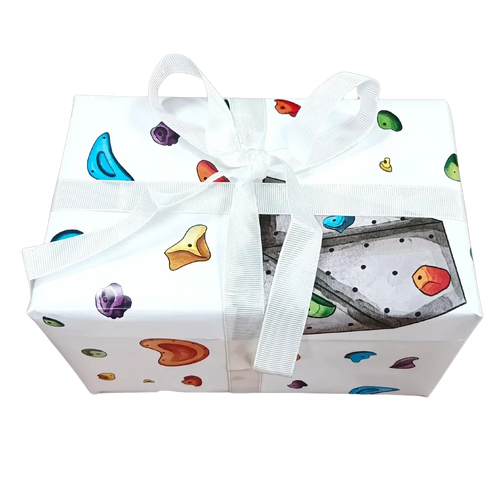
Boulder Block is sold direct at climbersgift.com. Since February 2024, we have shipped 25,286 orders to more than 50 countries. Orders arrive gift-ready, with no prices in the box, which is useful whether the block is being bought for a workplace, a household, or as a direct gift.
Customs duties are pre-paid, so the checkout price is the final price. We also offer 60-day money-back returns. If a hold breaks, we replace it free with no proof required.
Those details do not change the purpose of the product. They simply make it easier to order without uncertainty. The Boulder Block is a small game with a clear challenge: choose a route, hold the block, and climb it with your fingers. For professionals who are trying to make an activity more inviting, that can be the useful part.