

Buying guide
Building a child's hand strength at home, by age
The short answer
Fine motor skill is built by repeated hand use, and most of what builds it is free. Under five, modeling dough, threading beads and a busy board do more than anything you can buy. From about six, the everyday jobs matter most — opening their own packaging, laces, chopsticks, helping in the kitchen — because the skill and the independence are the same thing. Where a bought object earns its place is when a child has outgrown the simple stuff and needs a challenge with levels, which is what Boulder Block™ ($69.99) is: a wooden block with twelve resin climbing holds and 16 graded routes.
What actually works, cheapest first
The jobs they already have Free
Opening their own packaging, tying their own laces, peeling their own orange, carrying and pouring in the kitchen. Teachers in our own comment threads make this point more forcefully than we would: a primary teacher of 27 years stopped opening lunch packets and told the children to use the scissors in their desks, and within a fortnight nobody asked. It costs nothing and it is the only item on this list that also buys independence.
Chopsticks, tweezers and tongs Free to cheap
A parent in our threads pointed out that using chopsticks properly takes a real combination of finger strength and dexterity, and that it is simply normal practice in households that use them. Transfer games with tweezers do the same job in a classroom. Both isolate the pincer grip that sits under scissors and a pencil.
Modeling dough, putty and slime Ages 2-5
The cheapest and most effective starting point. Squeezing, rolling and pinching load the whole hand, and small children will do it for a long time without being asked. Nothing else in this list beats it before about five.
Busy boards, threading and lacing Ages 2-6
Zippers, buttons, ties and beads on a lace, on one board a child can work along. A parent in our threads makes the case for starting here well before school age, and you can build one yourself. It trains the pincer grip and the two hands working together, which is the pattern underneath both scissors and handwriting.
Construction bricks and building sets Ages 4+
Pressing, separating and placing small pieces asks for real finger force and precision, and the build is its own motivation, which is why these outlast most fine motor toys in the box. Parents in our threads are emphatic that they work best unstructured rather than as a pre-made kit.
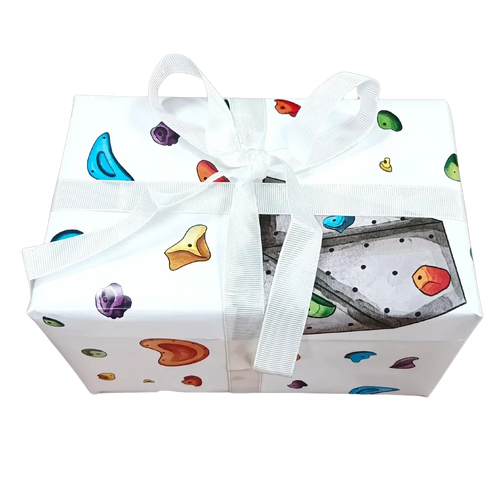
Boulder Block™Ours
A wooden block about 10cm across with twelve resin climbing holds and a deck of 16 routes across four levels, climbed with the fingers. It is last on this list on purpose: everything above it is cheaper and several are free. Where it earns its place is the child who has outgrown dough and tweezers and needs something that stays hard — it has levels, so it does not get finished.
Side by side
| Everyday jobs | Dough and putty | Busy boards, threading | Construction bricks | Boulder Block™ | |
|---|---|---|---|---|---|
| Roughly suits | Free | 2-5 | 2-6 | 4+ | About 8+, comfortable from 10 |
| Main hand skill | Whole hand, in real tasks | Whole-hand strength | Pincer grip, two hands together | Finger force and precision | Finger strength, pinch and grip |
| Gets harder over time | Yes — the jobs get bigger | Not really | A little | Yes | Yes — 4 levels, 16 routes |
| Played without being asked | Has to be handed over | Usually | Sometimes | Usually | The reason we built it |
| Typical cost | Free | Low | Low | Moderate to high | $69.99 |
| Adults use it too | n/a | No | No | Sometimes | Yes |
Age ranges are indicative and children vary enormously. Costs are typical retail ranges; the Boulder Block figure is its US list price in September 2026.
How to choose
-
Pick for the second week, not the first afternoon
Almost every toy in this category works while it is new. The one that changes anything is the one still being picked up a month later, so the question worth asking in the shop is not whether it trains the hand but whether this particular child will go back to it.
-
Match it to where the child actually is
A tweezer set given to a nine-year-old is boring, and a challenge toy given to a three-year-old is just frustrating. Most of the disappointment in this category is a mismatch of level rather than a bad toy.
-
Look for something that gets harder
Hands adapt to what you ask of them, so a toy with one difficulty stops doing anything once it is mastered. Levels, or a way to make the task smaller and finer, are what keep it useful past the first few weeks.
-
Screen-free is not the same as engaging
Plenty of things are technically screen-free and still lose to a tablet in an honest fight. The realistic test is whether the object can win that fight on its own, without an adult standing over it.
Questions parents ask
What are the best toys for fine motor skills?
It depends on age, and the honest answer is that most of it is free. Under five, modeling dough, a busy board and threading beads are hard to beat. From about six, the everyday jobs do the most work — opening their own packaging, laces, chopsticks, helping in the kitchen. A bought toy is worth it mainly when a child has outgrown the simple things and needs a challenge that gets harder.
Why does hand strength matter beyond handwriting?
Because it is the same thing as being able to do things without asking. The teachers and parents in our comment threads keep returning to this: a child who cannot open their own lunch has to find an adult, and a child who can, does not. That is the part that lasts longer than the pencil grip.
My child struggles with scissors. What actually helps at home?
Cutting is a two-handed skill built on hand strength and a stable pincer grip, so the useful practice is anything that makes the hand squeeze, pinch and hold while the other hand does something different — dough, tweezers, threading, tearing paper. If you are worried about a specific difficulty, that is a conversation for your child's teacher or an occupational therapist, not for a shopping list.
Do these toys help with handwriting?
Handwriting rests on hand strength, endurance and fine control, and the toys in this list all ask for some of those. What no toy can promise is a particular outcome for a particular child, and anyone telling you otherwise is selling harder than the evidence allows.
How do I get my child off the tablet without a fight?
Substituting something that is less fun rarely works. What parents in our threads describe working is replacing it with something that is also a challenge — with levels, a score, or a sibling to beat — because that is what the screen is actually providing. Several make the same point about stepping back and letting a child work something out rather than supervising it.
What age is the Boulder Block for?
There is one size, and it is sized for an adult hand — about 10cm across, roughly a large orange. That makes it an older-child and adult object rather than a young child's toy. In our own order and comment data the youngest recipients are around eight, almost always children who already climb, and one buyer choosing it for an eight-year-old told us they were worried it might be too large. From about ten it is comfortable. Hand size matters more than birthday, so if you are buying for a small pair of hands, judge it against an orange rather than against an age.
Is this my fault for giving them a tablet?
No, and the threads where parents blame each other for this are the least useful place to look for help. Nothing in a modern house asks much of a child's hands — that is a design fact about the house, not a verdict on the parent. The practical response is to put a few things back that do.
Are fidget toys the same thing?
Not quite. Most fidget toys are designed to occupy a hand rather than to challenge it, which is why they rarely get harder and rarely build anything. It is the difference between something to do with your hands and something your hands have to get better at.
Sources
- 1. Fine motor skills — development and activities — The OT Toolbox
- 2. What is Occupational Therapy? — American Occupational Therapy Association
- 3. Hand therapy exercises and hand strength background — Flint Rehab
- 4. Boulder Block Honest Review — an orthopedic occupational therapist's independent assessment — ChadGOrthoOT (YouTube)
- 5. Boulder Block™ — full specification — Climber's Gift
Written from our own post-purchase survey and from 267 comments left on our advertising by parents, teachers and therapists — including a primary teacher of 27 years, a piano teacher of 40 years, a retired special-education teacher and an educational assistant, all of whom volunteered their experience unprompted. We sell one of the products on this list and have put it last, after four things that cost nothing. Nothing here is clinical advice; a specific concern about a specific child belongs with their teacher or an occupational therapist.
Twelve real climbing holds, 16 routes, four levels. Sixty days to change your mind.
See the Boulder Block