

A home training week rarely goes exactly to plan. The session that happens is often the one that is easy to begin: something within reach after work, while the kettle boils, or during a quiet break between other things. That is where Boulder Block™ fits. It is a finger-climbing game made to be picked up, put down, and returned to without setting up a full session.
A hangboard is the stronger training tool when the goal is focused finger-strength work. It is built for that job. Boulder Block has a different role: it is small enough to live on a desk, shelf, or coffee table, and interesting enough that people tend to pick it up daily. The activity asks your fingers to find, hold, and move between small climbing holds while you work through a route.
A small climbing challenge at home
Boulder Block is a wooden block about 10cm across, roughly the size of a large orange. It sits comfortably in one adult hand. Rather than mounting it on a wall or using it like gym equipment, you hold it and climb it with your fingers.
Its surface has twelve screw-on resin climbing holds, made from the same material used on a climbing wall. Each hold can be removed with an Allen key, so the arrangement can be rebuilt into a different route. The block comes with a printed deck of 32 routes across 4 levels, from Yellow through Purple.
That format gives a home session a clear beginning and end. Pick a card, place your fingers where the route starts, and work through the indicated holds. A route may be something to return to until the sequence makes sense, or simply a brief bit of climbing play between larger tasks. There is no wall to install, no floor space to clear, and no need to turn the room into a training area.
Where it belongs in a week
For climbers who already use a hangboard, Boulder Block can sit alongside it rather than replace it. Keep the hangboard for the structured work it is designed to do. Keep the block nearby for the moments when a planned session is not realistic, but handling a route still sounds good.
On a day with a full climbing session planned, it can be left alone. On a quieter day at home, a route or two can offer a compact climbing task without needing a long block of time. On a rest day from climbing, it can remain just a game, with no expectation to turn every spare moment into training.
The useful distinction is intent. A hangboard session is deliberate, repeatable, and usually planned. Boulder Block is more casual. It rewards attention to sequence, contact, and the puzzle of getting from one hold to the next with the fingers available. Because it is easy to pick up, it is also easy to stop. That makes it a natural object to have around, rather than another piece of equipment waiting for a dedicated slot in the calendar.
If you are looking for a more structured overview of training finger strength at home, start by deciding what kind of session you want from each tool. The block is best understood as the daily, hands-on game in that mix, not as a substitute for a properly planned hangboard workout.
Routes keep the experience moving
The route deck matters because it gives the holds a purpose. Without a route, a small object with climbing holds can become something you squeeze absentmindedly. With a card in front of you, there is a sequence to solve. You are deciding how to place a finger, when to move, and which hold comes next.
Yellow routes provide a place to begin. As the colors progress toward Purple, the route ideas ask for more precision and attention. You do not need to invent a challenge every time you pick it up. Choose a card and follow it, then return to another route later.
When the existing layout begins to feel familiar, the holds can be changed. Loosen them with the Allen key, rearrange the twelve resin holds, tighten them again, and the same deck becomes a different experience. Rebuilding is part of the point. It keeps the object from being fixed in a single arrangement and lets the route deck continue to offer new puzzles.
Why the original construction matters
There has been confusion around copies. Buyers have told us that many copies are molded plastic in one piece rather than made with screw-on resin holds, and that they usually arrive without a route deck. We have also heard direct descriptions from buyers of copies: “slippery,” “slick,” “the holds have no texture to them,” “plastic and slippy,” and “too slick and actually dangerous as the slippery plastic makes it shoot out of your hands.”
Those are buyers’ accounts, not our testing of another seller’s product. But the difference in construction is straightforward. Boulder Block uses separate resin climbing holds that can be unscrewed and moved. The deck is part of the game, giving the block routes to climb instead of leaving the owner to guess what to do with it.
For a clear guide to the details, read about telling the original from a copy. It explains what to look for when the photos and listings start to blur together.
One size, with hands in mind
Boulder Block comes in one size, made for an adult hand. It suits roughly age 8 and up and is comfortable from about 10, though hand size matters more than age. A child with larger hands may find it comfortable sooner, while someone with smaller hands may prefer to wait. It is worth treating comfort and control as the guide rather than treating an age label as a rule.
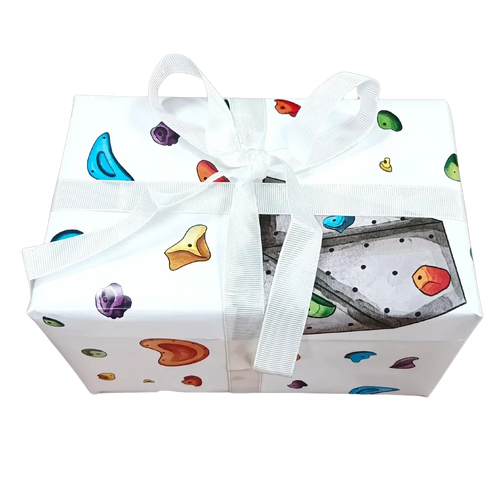
Because it is a hand-held game, it also makes a considered gift for a climber who already has the major gear they need. It arrives gift-ready, with no prices in the box. There is no wall-mounting project to hand over and no special place required to start using it.
Buying directly from Climber's Gift
Climber's Gift sells Boulder Block™ directly at climbersgift.com. Since February 2024, we have shipped 25,286 orders to 50+ countries. Customs duties are pre-paid, so the checkout price is final. If it is not right for the recipient or the routine, there are 60-day money-back returns.
If a hold breaks, we replace it free, with no proof required. The holds are made to be removed and rearranged, so straightforward support matters. We want the game to remain usable when it is picked up often, rebuilt, and passed around.
Indoor climbing at home does not have to mean trying to recreate a wall or force a serious session into every evening. A hangboard remains the stronger tool for dedicated finger training. Boulder Block earns its place differently: it is a compact route puzzle that is ready when there is a spare moment, and compelling enough to be picked up again tomorrow.